
Artificial sweeteners like sucralose are often sold in small packets as zero-calorie sugar substitutes. Monk fruit sweetener, made from a fruit extract, is another sugar-free option, but each has different taste and safety profiles.
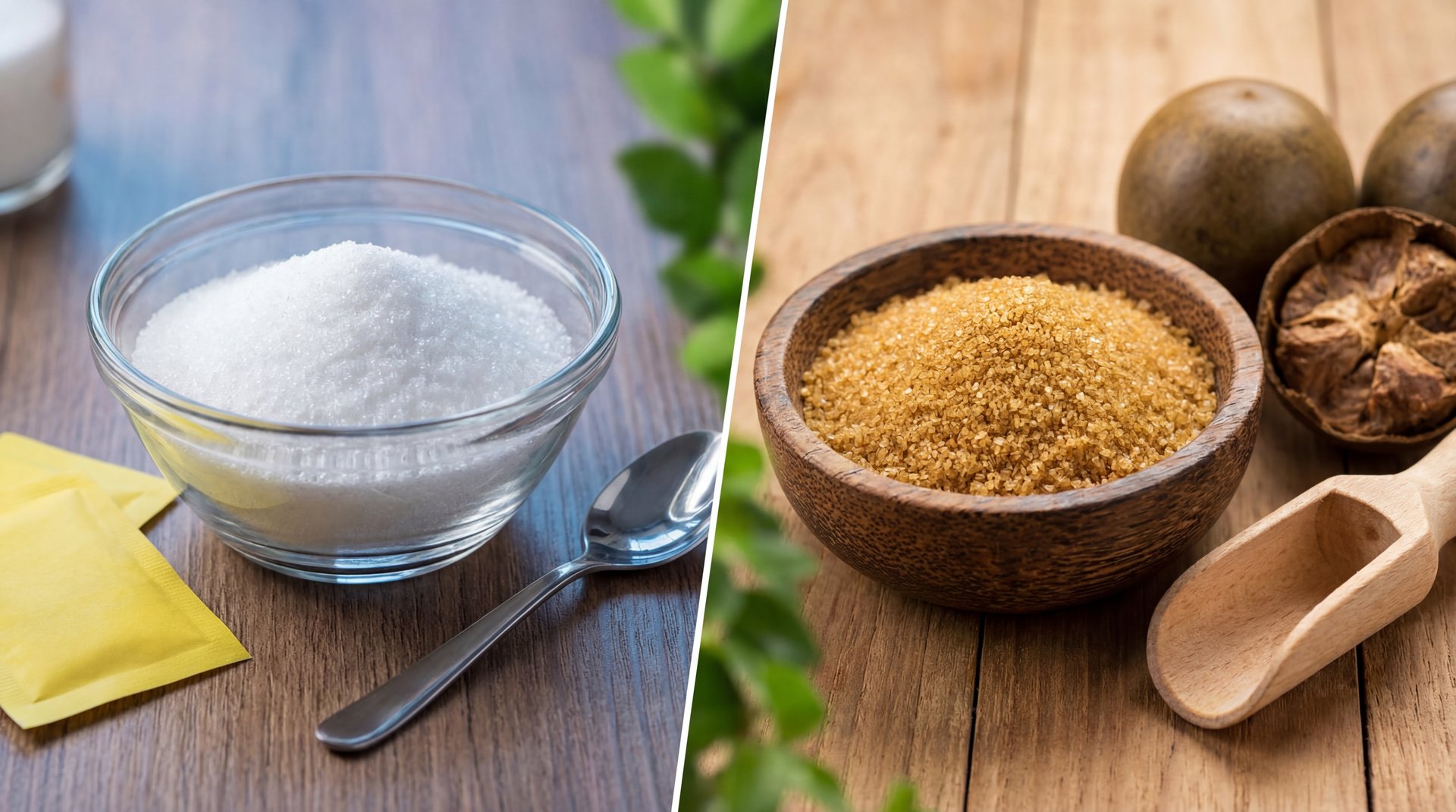
Sucralose and monk fruit are two popular sugar-free sweeteners. Sucralose is an artificial sweetener created in a lab, while monk fruit (also known as luo han guo) is a natural sweetener made from a fruit. Both are much sweeter than sugar – sucralose is about 600 times sweeter than regular sugar, and monk fruit extract is about 100–250 times sweeter. This means only a tiny amount is needed to sweeten foods or drinks. People often wonder which sweetener is safer or better. In this blog, we will explain in very simple terms why sucralose is safe (backed by scientific research and global food safety authorities), bust some myths about artificial sweeteners, and compare sucralose to monk fruit. We’ll also share why, despite monk fruit being “natural,” it has some drawbacks (like a bitter aftertaste and less consistency in taste), whereas the sucralose in Nova Prime Blend is used in a very small, safe amount that gives great flavor without risk. Let’s dive in!
Sucralose Safety: Proven by Research and Regulators

Sucralose is one of the most tested food ingredients in the world. Before approving it, the U.S. Food and Drug Administration (FDA) reviewed over 110 studies to make sure sucralose was safe. These studies looked for any bad effects on health, including checks for cancer, nerve damage, or effects on organs. No harms were found. In 1998, the FDA approved sucralose for use in foods, and by 1999 it was allowed as a general sweetener in all kinds of foods and drinks. This means experts found it safe for everyday consumption. In fact, FDA scientists concluded that sucralose is safe for all people, including children and people with diabetes (unlike some sweeteners, sucralose doesn’t affect blood sugar).
Global health organizations agree on sucralose’s safety. For example, in 1998 the Joint Expert Committee on Food Additives (an international scientific panel from the World Health Organization and United Nations) classified sucralose as a safe food additive. Food safety authorities in Europe (EFSA) and other countries have also examined sucralose and confirmed it poses no safety concerns. In other words, whether in the USA, Europe, or elsewhere, regulators universally say sucralose is safe when used as intended.
Quick Facts on Sucralose Safety
-
Thoroughly Tested: Sucralose is among the most thoroughly tested ingredients, with more than 110 studies over 20 years confirming its safety. It has been on the market for decades with no credible evidence of harm.
-
No Cancer Risk: Despite internet myths, studies have found no link between sucralose and cancer or any other serious disease. Major health organizations like the U.S. National Cancer Institute and the American Cancer Society say that current evidence does not show any cancer risk from approved sweeteners like sucralose. In other words, sucralose does not cause cancer.
-
Safe for All Populations: Sucralose can be used by the general population. The FDA has stated it’s even safe for children, pregnant women, and people with diabetes in normal amounts. It doesn’t add calories or spike blood sugar, making it a helpful option for those watching sugar intake.
-
Accepted Daily Intake: Scientists set an acceptable daily intake (ADI) for sucralose to ensure long-term safety. In the U.S., the ADI for sucralose is 5 milligrams per kilogram of body weight per day. (For an adult around 60 kg/132 lb, that’s about 300 mg of sucralose per day.) International experts (WHO/JECFA) are even more conservative, allowing up to 15 mg/kg/day, showing a wide margin of safety. These limits are far above what an average person would ever consume.
To put that in perspective, you would have to consume an extremely large amount of sucralose to reach a harmful dose. The FDA illustrated this with common sweetener packets: an adult would need to eat about 23 packets of sucralose sweetener in one day to hit the safety limit, and even then it’s within safe levels, not a toxic dose. (Most people never consume anywhere near that much sucralose in a day!) One scientific review noted that the amount of sucralose found safe in studies equaled the sweetness of over 40 pounds of sugar per day, every day for life. Of course, no one would ever eat that much sweetness in reality. This huge safety buffer shows that normal use of sucralose is nowhere close to dangerous levels.
Furthermore, sucralose is unique in how our bodies handle it: we don’t absorb most of it. Sucralose is made from sugar but altered so that the body does not break it down for calories. Studies show about 85% of sucralose passes through the body undigested and is eliminated, and the small amount that is absorbed is excreted without causing harm. It doesn’t build up in the body or get metabolized into anything harmful. This adds to its safety – it just gives sweet taste and then leaves the body.
Busting Myths About Artificial Sweeteners (Especially Sucralose)
Because sucralose is “artificial,” some people have worries due to misinformation. Let’s clear up common myths with facts:
1. “It’s artificial, so it must be unhealthy.”
“Artificial” is not a scientific risk category. It simply means a substance was created or modified in a lab.
Safety is determined by toxicology, dosage, metabolism, and long-term human data, not whether something is labeled natural.
Sucralose has undergone more than 110 safety studies before approval and decades of global use. Regulatory bodies including the FDA, EFSA (Europe), and JECFA (WHO/UN) have all concluded it is safe within established intake levels.
Natural does not automatically mean safer. Safety depends on dose and evidence, not marketing language.
2. “Sucralose causes cancer.”
This claim is not supported by human evidence.
Major health authorities including the FDA and the U.S. National Cancer Institute state there is no consistent evidence that approved non-caloric sweeteners cause cancer in humans.
Sucralose has been evaluated in long-term animal studies and human research without demonstrating carcinogenic effects at normal intake levels.
The acceptable daily intake already includes a large safety buffer built in.
3. “It messes up your metabolism.”
Controlled human trials show that replacing sugar with non-caloric sweeteners like sucralose:
-
Reduces calorie intake
-
Does not raise blood glucose
-
Does not meaningfully spike insulin
-
Supports weight management when used instead of sugar
Sucralose contains zero calories. It does not behave like sugar in the body.
If anything, removing sugar from the equation improves metabolic load.
4. “It destroys your gut microbiome.”
This concern largely stems from high-dose rodent studies or studies using blended sweetener products, not realistic human consumption.
Human clinical data does not show clinically meaningful microbiome damage at normal intake levels.
Dose matters. The 100 mg used in Nova Prime Blend is well within standard dietary exposure and far below toxicological thresholds.
5. “It increases cravings.”
The data does not support a consistent biological mechanism where sucralose increases hunger compared to water.
Some individuals psychologically associate sweetness with wanting more sweetness, but that applies to any sweet flavor, including sugar or monk fruit.
In controlled settings, replacing sugar with non-caloric sweeteners typically reduces overall calorie intake.
6. “It contains chlorine.”
This is a chemistry misunderstanding.
Sucralose contains chlorine atoms. So does table salt. So does the chloride in stomach acid.
Chemical safety depends on molecular structure, not the presence of a specific atom.
Sucralose is chemically stable and largely passes through the body without being metabolized into harmful compounds.
In summary, the negative myths about sucralose are not supported by scientific evidence. Misinformation sometimes makes people unnecessarily afraid of artificial sweeteners. But the facts show sucralose is a safe option to enjoy sweetness without sugar’s calories. Now, that doesn’t mean you should consume unlimited quantities of any sweetener. Moderation is key in a healthy diet, but it does mean that a little sucralose in your drink or supplement is nothing to worry about.
Natural Isn’t Always Better: Monk Fruit’s Drawbacks
:max_bytes(150000):strip_icc()/__opt__aboutcom__coeus__resources__content_migration__mnn__images__2013__12__MonkFruit-3d05462d9df748b6b4de257bde1cee12.jpg)
It’s understandable that many people instinctively prefer something labeled “natural” like monk fruit over something “artificial” like sucralose. Monk fruit sweetener is indeed derived from a fruit and has been used in foods as a natural, zero-calorie sweetener. It’s recognized as safe by the FDA as well – monk fruit extract is considered GRAS (Generally Recognized As Safe) for use as a sweetener. So, monk fruit is a fine choice for those who enjoy it. However, “natural” does not automatically mean “better” in every way. Monk fruit sweeteners come with some practical drawbacks that are important to understand:
-
Taste and Aftertaste: Monk fruit extract is very sweet, but many people report it doesn’t taste the same as sugar. In fact, monk fruit can have a slight aftertaste. Some describe it as fruity or herbal, while others find it bitter or metallic. The aftertaste is usually milder than that of stevia (another natural sweetener), but it’s still there for certain people. This means a drink or product sweetened only with monk fruit might not have a purely sugar-like taste. In contrast, sucralose is formulated to taste very similar to sugar without a bitter aftertaste, which is why it’s often praised for having a more sugar-like flavor.
-
Consistency and Blending: Because monk fruit extract is extremely sweet (hundreds of times sweeter than sugar), only a tiny bit is needed for sweetness. While that sounds good, it actually creates a challenge: how do you measure and mix such a small amount evenly into foods? The solution most companies use is to blend monk fruit extract with other ingredients (like erythritol, a sugar alcohol, or maltodextrin) to bulk it up and make it measurable. As a result, many “monk fruit” sweetener products in stores are actually monk fruit mixed with other sweeteners. These fillers can affect taste and texture. For example, erythritol (commonly mixed with monk fruit) can add a cooling effect or slight aftertaste of its own, and some people get digestive upset from sugar alcohols. Moreover, since different brands use different mixes, the sweetness can vary from brand to brand. One monk fruit blend might be sweeter or have more aftertaste than another. This can make the results less consistent when you use monk fruit in recipes – you might need to adjust amounts and you might notice a difference in flavor depending on the product. In contrast, sucralose is used in very pure form (often just dissolved evenly in the product or in a consistent carrier like a sucralose-water solution in beverages), leading to very uniform sweetness and taste every time.
-
Limited Culinary Use: Monk fruit sweetener works well in many cases, but it isn’t a perfect swap for sugar in all cooking. Because it lacks bulk and some of sugar’s browning and texturing properties, purely using monk fruit in baking, for example, can be tricky (often other bulking agents or sugars are needed to get the right texture). Sucralose, while also lacking bulk, has the advantage of being very heat-stable – it can be used in baking and cooking without losing sweetness. Monk fruit’s stability is generally good too, but recipes may require some trial and error. Manufacturers sometimes mix monk fruit with other sweeteners to improve functionality, which again means you’re not actually getting a single “natural” ingredient but a blend.
-
Availability and Cost: Monk fruit (the fruit itself) is grown mostly in parts of Asia, and producing the extract can be costly. Pure monk fruit extract can be more expensive than sucralose for sweetening large amounts. While cost might not affect you when it’s just a small packet in coffee, it can affect food and beverage companies deciding on a sweetener for their product. Sucralose is less expensive and more readily available in large scale, which is one reason it’s widely used. Natural doesn’t always mean sustainable or affordable at scale. (If a product tried to use only monk fruit for sweetness, it might end up quite pricey or in short supply.) That’s why you often see monk fruit combined with other sweeteners – to keep costs sensible and ensure there’s enough sweetness.
It’s worth noting that monk fruit is safe. There are no known harmful effects, and it’s a great option for people who enjoy the taste. But even supporters of monk fruit acknowledge these issues: taste differences, blending requirements, and higher cost. For example, a food industry analysis noted that monk fruit extract still has some “off” taste for certain consumers and that formulators often blend it with other sweeteners to mask aftertaste. In short, monk fruit sweetener is natural but may not deliver the perfect taste on its own.
Natural vs. Artificial – Perception vs Reality: People often choose monk fruit or stevia thinking “natural = healthier or safer.” However, in terms of safety, approved artificial sweeteners like sucralose are just as safe as natural ones. They are all tested and monitored. The choice really comes down to taste and usage. If a “natural” sweetener doesn’t taste good in a product (or needs to be mixed with other additives), then that benefit of being natural becomes less meaningful. In fact, one industry expert pointed out that manufacturers continue to use artificial sweeteners because they often taste better than most natural alternatives – they give a cleaner sweet taste closer to sugar, with fewer aftertaste issues. This is a key reason many products, especially those that need a true sugar-like flavor (like sodas, sports drinks, or supplements), opt for sucralose or similar sweeteners.
To sum up, monk fruit is a good sugar-free sweetener and it’s natural, which appeals to many. But it has a bitter/odd aftertaste for some people, can vary by brand, and is usually combined with other ingredients. Sucralose, while artificial, provides a very consistent, sugar-like sweetness without bitterness, and only a minuscule amount is needed.
Nova Prime Blend Sweetener: 100 mg of Sucralose for Safe, Superior Flavor

Now let’s talk about Nova Prime Blend and why it uses sucralose (an artificial sweetener) rather than relying on monk fruit alone. Nova Prime Blend is formulated with both great taste and consumer safety in mind. One serving of Nova Prime Blend contains 100 milligrams of sucralose. That is a very small amount – equal to just 0.1 gram, which is about the weight of a sprinkle of salt. This tiny bit of sucralose provides enough sweetness to make the product taste great without sugar. Importantly, 100 mg is far below any risk thresholds set by health authorities:
-
As mentioned, an adult would need around 300 mg per day (for a 60 kg person) to reach the FDA’s safe intake limit, and even higher according to global standards. Nova Prime Blend’s 100 mg per serving is well under this amount. Even if you had multiple servings in a day, you’d still be within safe limits. For example, consuming three servings (300 mg sucralose) is about equal to the FDA’s ADI for a 132-pound person – and even that ADI already has a huge safety cushion built in. Most people will consume far less than the ADI with Nova’s recommended use.
-
Another way to see it: The FDA’s chart suggests ~23 packets of sucralose sweetener a day for a person to hit the ADI. Nova Prime Blend uses roughly the sucralose equivalent of only 1–2 of those packets per serving. That’s truly a small amount. In daily life, many people use more sweetener in a couple of diet sodas or coffees than what’s in one serving of Nova Prime Blend. So you can be confident that the sucralose in Nova Prime Blend is well within safe consumption levels.
Why choose sucralose for Nova Prime Blend’s sweetener? The goal of Nova’s formulation is to give you a product that not only is safe, but also tastes excellent and is consistent every time. Sucralose helps achieve that in several ways:
-
Superior Taste: Sucralose provides a clean sweetness that very closely mimics sugar’s taste, with no bitterness or strange after-notes. This means Nova Prime Blend has a pleasant flavor without needing any sugar. In contrast, using monk fruit alone might have introduced a subtle aftertaste or required additional sweetening agents to balance flavor. By using a tiny bit of sucralose, Nova Prime can ensure a delicious, sugar-like sweetness that users love, without any sugar and without any unpleasant aftertaste.
-
Consistency in Flavor: Because sucralose is a single, pure compound, it delivers the same sweetness every time, and it mixes uniformly in the blend. Nova Prime Blend’s recipe is carefully calibrated so that each batch has the same sweetness level. With sucralose, there’s no risk that one batch will be less sweet or have a different taste than another. Monk fruit extracts can vary (and often come mixed with other sweeteners as we discussed), which could lead to inconsistency. Nova Prime avoids that by using sucralose for a reliable result in every serving.
-
Stability and Function: Nova Prime Blend might be something you mix into a beverage or consume under various conditions. Sucralose is very stable in liquids and across a range of temperatures and pH levels. It doesn’t break down easily, ensuring that the sweetness of Nova Prime stays true whether it’s mixed in cold water, stirred in a shake, or stored on the shelf. Monk fruit, while generally stable, sometimes can degrade or lose potency in certain formulations, and often it’s paired with preservatives or other agents when used in products. Sucralose doesn’t require any such helpers – it simply sweetens and stays effective.
-
Minimal Amount for Max Effect: The fact that only 100 mg of sucralose is needed means that Nova Prime Blend can keep other ingredients focused on nutrition and performance (if Nova Prime is a supplement or beverage, for example). The sweetener isn’t taking up much space at all. If monk fruit were used to get comparable sweetness, it might require a larger volume of filler (like several grams of erythritol or maltodextrin mixed with it) to distribute that sweetness, which could add extra carbs or alter the product’s nutritional profile. By using sucralose, Nova Prime keeps the formula lean – essentially zero sugars, negligible added substances, just pure sweetening power.
In short, the choice of sucralose in Nova Prime Blend is very intentional: it ensures the product is completely sugar-free, extremely safe (with a huge margin below any risk level), and tastes fantastic without the downsides of some natural sweeteners. Nova Prime’s blend does not rely on big amounts of any sweetener – just a tiny safe pinch of sucralose that does the job elegantly.
How Much Sucralose Is in Popular Products?
To better understand how small 100 mg of sucralose really is, it helps to compare it to other well-known products that millions of people consume daily.
Here are approximate amounts of sucralose found in common beverages and sweeteners:
-
Celsius Energy Drink (12 oz can): ~100 mg of sucralose
-
Diet Mountain Dew (12 oz can): ~68 mg of sucralose
-
Gatorade Zero (20 oz bottle): ~60–70 mg of sucralose
-
Splenda packet (single serve): ~12 mg of sucralose
-
Protein powders and pre-workouts: Often 50–150 mg per serving depending on flavor intensity
For context:
The FDA acceptable daily intake (ADI) for sucralose is 5 mg per kilogram of body weight per day.
For a 180-pound adult (about 82 kg), that equals 410 mg per day.
That means someone would need to consume:
-
Four Celsius cans in a day
-
Or roughly 6–7 Diet Mountain Dews
-
Or more than 30 Splenda packets
just to reach the conservative FDA safety threshold.
Conclusion: Confidence in Nova Prime Blend’s Sweetness and Safety
After looking at the facts, we can confidently say that sucralose is a safe and smart choice when you want sweet taste without sugar. It has been rigorously tested and approved by health authorities worldwide, and it’s supported by decades of safe use. The scary stories you might read online about sucralose are not backed by real science. In reality, using a little sucralose (like the 100 mg in Nova Prime Blend) is perfectly safe – far below any level of concern – and it can actually help you enjoy a sweet flavor while avoiding the negatives of sugar (excess calories, blood sugar spikes, tooth decay).
Monk fruit, while natural and also safe, comes with issues of taste and consistency (some people don’t like the aftertaste, and product formulations with monk fruit can be less uniform). Nova Prime Blend acknowledges those drawbacks and uses monk fruit sparingly if at all, instead relying on sucralose to deliver a reliably delicious sweetness. The result is a product that tastes great every time, without any sugar and without any bitterness.
You can feel assured about the sucralose in Nova Prime Blend. The amount used is very small and well within safe limits, as established by extensive research and regulatory oversight. Nova Prime Blend’s formulation was developed with both flavor and your health in mind – choosing an ingredient that gives the best taste and maintains the highest safety standards. So when you enjoy Nova Prime Blend, you’re getting the benefit of a science-backed sweetener that enhances flavor but won’t harm your body in the amounts provided.
In the “artificial vs natural sweetener” debate, the key is to rely on good science. The science says sucralose is safe. Nova Prime Blend has taken that science to heart, using sucralose in a responsible way to create a product you can trust. In conclusion, you can be confident in Nova Prime Blend’s sweetener choice: it’s there to make the product tasty, effective, and totally guilt-free. Enjoy the sweetness, knowing that it’s backed by solid research and careful formulation. Here’s to a sweet flavor and peace of mind about what you’re consuming!
References:
-
FDA – “Safe Levels of Sweeteners” (ADI and sweetener packet chart, showing sucralose safety margin).
-
Aguayo-Guerrero et al., 2024 – MDPI Nutrients (Review stating JECFA and FDA found sucralose safe, including for children/diabetics).
-
Calorie Control Council – “EFSA Confirms Safety of Sucralose” (Global consensus that regulatory bodies find sucralose safe).
-
International Sweeteners Association – “Sucralose poses no safety concern” (Reaffirms sucralose safety, 110 studies confirming no cancer risk).
-
Calorie Control Council – “Sucralose Myths – Setting the Record Straight” (No evidence of cancer or other harm; safe intake equivalent to >40 lbs of sugar per day).
-
Tasting Table – “Why You May Want to Avoid Monk Fruit Sweetener” (Monk fruit is FDA GRAS but with limited long-term research).
-
The Spruce Eats – “What Is Monk Fruit?” (Monk fruit sweetener can have a slight bitter aftertaste; often mixed with erythritol, which has its own aftertaste and digestive effects).
-
BeverageDaily (Mintel report) – Noting some natural sweeteners have taste issues and that artificial sweeteners often taste better than most natural ones.
